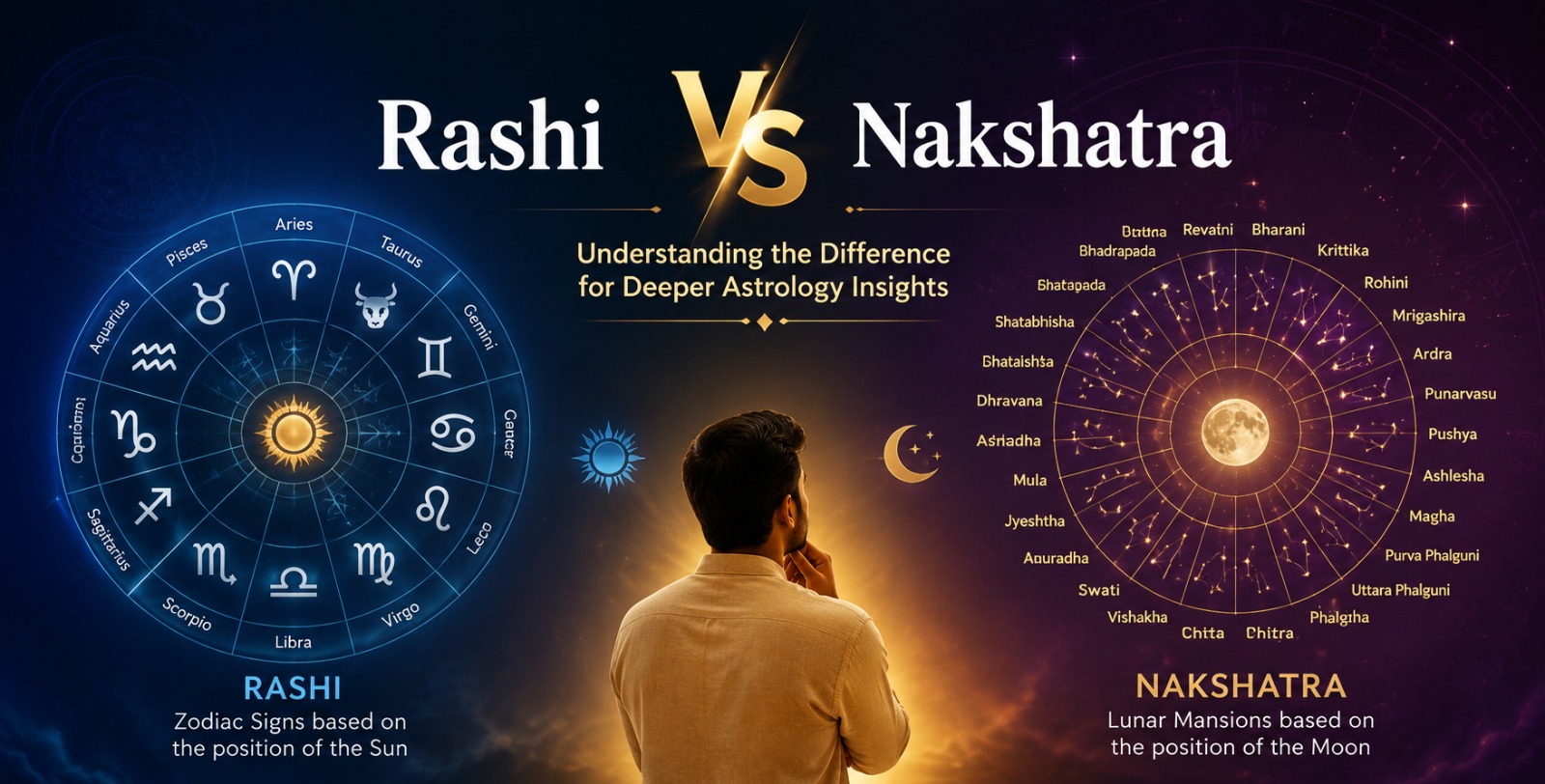
Rashi vs Nakshatra: What’s the Difference?
In Vedic Astrology, Rashi and Nakshatra are two important concepts used to understand the Moon's position at the time of birth. While many people use these terms interchangeably, Rashi and Nakshatra are not the same. Your Janma Rashi, commonly known as your Moon Sign, tells you which zodiac sign the Moon occupied at the time of your birth. Your Janma Nakshatra, also known as your Birth Star, tells you which Nakshatra the Moon was positioned in.
What Is Rashi in Vedic Astrology?
Rashi refers to the 12 zodiac signs in Vedic Astrology. The entire zodiac is divided into 12 equal parts, with each Rashi covering 30 degrees. The 12 Rashis are Mesha (Aries), Vrishabha (Taurus), Mithuna (Gemini), Karka (Cancer), Simha (Leo), Kanya (Virgo), Tula (Libra), Vrishchika (Scorpio), Dhanu (Sagittarius), Makara (Capricorn), Kumbha (Aquarius), and Meena (Pisces). When astrologers talk about your Janma Rashi, they generally mean the zodiac sign where the Moon was positioned at the time of your birth.
Why Is Janma Rashi Important?
In Vedic Astrology, the Moon is associated with the mind, emotions, thought patterns and inner nature. Therefore, Janma Rashi can be considered while understanding:
• Emotional tendencies
• Mental patterns
• General temperament
• Behaviour and reactions
• Relationship tendencies
• Transit effects
• Horoscope predictions
However, Rashi is only one part of a complete Kundli and should not be used alone for making detailed predictions.
What Is Nakshatra in Vedic Astrology?
Nakshatra refers to the lunar constellations used in Vedic Astrology. The zodiac is traditionally divided into 27 Nakshatras, with each Nakshatra covering approximately 13°20′. Some well-known Nakshatras include Ashwini, Bharani, Krittika, Rohini, Mrigashira, Ardra, Pushya, Magha, Hasta, Swati, Anuradha, Mula, Shravana, Dhanishta, Shatabhisha and Revati. The Nakshatra occupied by the Moon at the time of your birth is called your Janma Nakshatra or Birth Star.
Why Is Janma Nakshatra Important?
Nakshatra has an important role in traditional Vedic Astrology and can be considered for:
• Vimshottari Dasha
• Marriage compatibility
• Guna Milan
• Muhurat
• Personality analysis
• Understanding behavioural tendencies
• Timing of certain life events
• Nakshatra-based predictions
Each Nakshatra is further divided into four Padas, which can provide an additional level of detail during astrological analysis.
Rashi vs Nakshatra: What Is the Difference?
The simplest way to understand the difference is to look at how the zodiac is divided. The complete zodiac contains 360 degrees. The 12 Rashis divide these 360 degrees into 12 sections of 30 degrees each. The 27 Nakshatras divide the same zodiac into 27 sections of approximately 13°20′ each. So, Rashi gives a broader classification, while Nakshatra provides a more specific division of the zodiac. In simple terms:
Rashi = Zodiac Sign
Nakshatra = Lunar Constellation / Birth Star
Both are connected with the Moon's position at birth, but they provide different layers of information.
Can Two People Have the Same Rashi but Different Nakshatra?
Yes, absolutely. This is one of the easiest ways to understand the difference between Rashi and Nakshatra. For example, Mesha Rashi (Aries) covers 30 degrees of the zodiac. Within this area, parts of Ashwini, Bharani and Krittika Nakshatra fall. Therefore, two people can have the same Mesha Janma Rashi but different Janma Nakshatras. Their Moon is positioned in the same broad zodiac sign, but in different Nakshatra sections. This is one reason why two people with the same Moon Sign can still have noticeable differences in their personality, experiences and astrological interpretations.
Rashi or Nakshatra: Which One Is More Important?
This is one of the most common questions people ask. The answer is: both are important, but their importance depends on what is being analysed. Rashi provides the broader framework of the Moon's placement, while Nakshatra can add a deeper and more specific layer of interpretation.
What Is the Role of Nakshatra in Kundli Analysis?
One of the important reasons Nakshatra is significant in Vedic Astrology is its connection with Dasha systems. The Moon's birth Nakshatra is traditionally used to determine the starting point of the Vimshottari Dasha. These planetary periods are then studied to understand different phases of life. Nakshatra is also considered in areas such as marriage matching, Muhurat, personality analysis and timing-related astrological interpretation. Nakshatra and Marriage Nakshatra can play an important role in traditional Kundli matching. Factors such as Guna Milan, Nadi and Bhakoot are associated with the traditional compatibility assessment. However, marriage compatibility should not be judged only by Nakshatra. A more complete analysis may consider the 7th house, its lord, Venus, Jupiter, Mars, planetary aspects, Dashas and the overall compatibility of both Kundlis.
Rashi and Nakshatra in Marriage Compatibility
Many people search for their Rashi or Nakshatra when considering marriage compatibility. But simply knowing that two people have the same or different Rashi does not automatically determine whether they are compatible. Traditional Kundli matching may involve several factors, including:
• Janma Rashi
• Janma Nakshatra
• Guna Milan
• Nadi
• Bhakoot
• 7th house
• Venus and Jupiter
• Mars
• Planetary combinations
• Dashas
• Overall horoscope compatibility
This is why a detailed Kundli matching should be preferred over making a conclusion from one factor.
How Can You Find Your Rashi and Nakshatra?
To calculate your Janma Rashi and Janma Nakshatra, three details are generally required:
1.Date of Birth
2.Exact Time of Birth
3.Place of Birth
These details help determine the Moon's exact astronomical position at the time of birth. Accurate birth time can become especially important when the Moon is close to the boundary of a Rashi or Nakshatra.
Rashi vs Nakshatra: Which One Should You Know?
If you are beginning your journey into astrology, knowing your Janma Rashi and Janma Nakshatra is a useful starting point. But if you want to understand specific areas such as:
• Marriage
• Career
• Business
• Wealth
• Foreign travel
• Relationships
• Major life periods
• Doshas
• Yogas
• Planetary influences
then your complete Kundli needs to be considered. Your Rashi and Nakshatra can provide important clues, but they are not the entire horoscope.
Rashi vs Nakshatra: In Simple Words
If you want to remember the difference easily:
Rashi tells you the Zodiac Sign in which the Moon was placed at your birth.
Nakshatra tells you the specific lunar constellation in which the Moon was placed.
There are 12 Rashis and 27 Nakshatras, and each Nakshatra is divided into four Padas. Both are important components of Vedic Astrology, but they answer different questions and should be interpreted together with the complete Kundli.
Frequently Asked Questions
Is Rashi and Nakshatra the same?
No. Rashi refers to the zodiac sign, while Nakshatra refers to the lunar constellation or Birth Star. Both are determined from the Moon's position at the time of birth.
How many Rashis are there in Vedic Astrology?
There are 12 Rashis, and each Rashi covers 30 degrees of the zodiac.
How many Nakshatras are there?
There are traditionally 27 Nakshatras, and each Nakshatra covers approximately 13°20′.
What is Janma Rashi?
Janma Rashi is the zodiac sign occupied by the Moon at the time of birth. It is commonly known as the Moon Sign.
What is Janma Nakshatra?
Janma Nakshatra is the Nakshatra occupied by the Moon at the time of birth. It is also known as the Birth Star.
Can two people have the same Rashi but different Nakshatra?
Yes. A single Rashi can contain portions of more than one Nakshatra, so two people can have the same Rashi but different Nakshatras.
Which is more important: Rashi or Nakshatra?
Neither should be considered independently more important. They provide different information and are interpreted along with the other factors in a Kundli.
Final Thoughts
Understanding Rashi vs Nakshatra is an important step towards understanding Vedic Astrology beyond basic zodiac-sign predictions. Your Rashi provides the broader framework of the Moon's placement, while your Nakshatra gives a more specific layer of information. When these are studied alongside planetary positions, houses, Dashas, Yogas and transits, they can contribute to a much deeper interpretation of the birth chart. So, the next time someone asks, “What is your Rashi?”, don't stop there. Also discover your Janma Nakshatra. Because in Vedic Astrology, the more complete the Kundli analysis, the more meaningful the interpretation can be. Astrologer Mahesh Mankar, a Vedic Astrology expert, believes in analysing the horoscope as a whole rather than basing important life predictions on a single Rashi, Nakshatra or planetary placement.
Comments (0)
Be the first to share your reflections.